
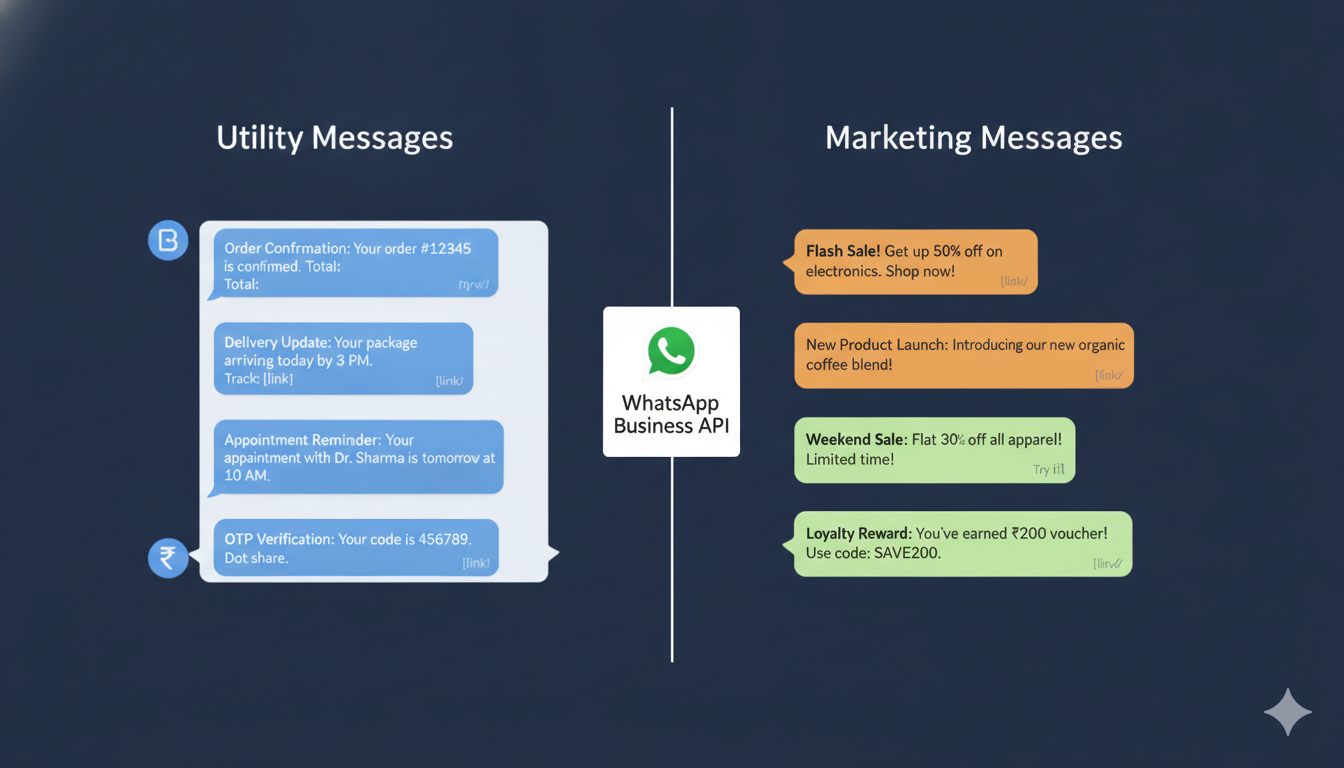
If you are using WhatsApp Business API for your business in India — or planning to — one of the most important things you need to understand is the difference between utility messages and marketing messages.
This distinction matters for two critical reasons.
First it affects how much you pay. WhatsApp Business API charges per conversation — and utility conversations and marketing conversations are priced differently. Understanding the difference helps you manage your WhatsApp API costs intelligently and avoid unexpected charges.
Second it affects what you can send and when. Using the wrong message category — sending what is essentially a marketing message under a utility template — violates Meta’s policies and can result in your templates being rejected or your account being restricted.
Yet despite how important this distinction is, it remains one of the most commonly misunderstood aspects of WhatsApp Business API for businesses across India — including those in Bhubaneswar and Odisha that we work with at Prominds Digital every day.
This complete guide explains exactly what utility messages and marketing messages are, how they differ, when to use each, how they are priced, real examples of each type for different Indian business categories, and the common mistakes to avoid when categorizing your WhatsApp API messages.
First — Understanding How WhatsApp Business API Charges Work
Before we get into the specific differences between utility and marketing messages it helps to understand the overall pricing structure of WhatsApp Business API — because the utility vs marketing distinction exists within this broader pricing framework.
WhatsApp Business API charges businesses per conversation — not per individual message. A conversation is defined as a 24-hour messaging window during which any number of messages can be exchanged between your business and a customer.
There are two types of conversations:
User-initiated conversations — The customer sends the first message to your business. These conversations are free for the first 1,000 per month for all businesses. Beyond 1,000 per month a small per-conversation charge applies.
Business-initiated conversations — Your business sends the first message to the customer. These conversations always require a pre-approved message template and are charged per conversation from the very first conversation — there is no free tier for business-initiated messages.
Within business-initiated conversations Meta further divides conversations into categories based on the nature and purpose of the message. The three main categories are:
- Utility — Transactional and operational messages
- Marketing — Promotional and engagement messages
- Authentication — One-time passwords and verification codes
Each category is charged at a different rate — and utility messages are typically priced lower than marketing messages. Understanding which category your message falls into is essential for both compliance and cost management.
What Are WhatsApp API Utility Messages?
Utility messages are transactional, operational, or informational messages that are directly related to a specific transaction, service, or request that the customer has already initiated or agreed to.
The defining characteristic of a utility message is that it serves a functional purpose for the customer — it provides information they specifically need about something they have already done or something they are actively waiting for.
Utility messages are not promotional. They do not pitch products or services. They do not contain marketing language or calls to action designed to drive new purchases. They fulfill a specific operational need that arises from an existing customer relationship or transaction.
Characteristics of Utility Messages
Transaction-specific — The message relates directly to a specific transaction, booking, order, or service the customer has already initiated.
Expected by the customer — The customer is actively expecting or would naturally expect this message as part of their interaction with your business.
Informational rather than promotional — The primary purpose is to inform, confirm, or update — not to sell or promote.
Time-sensitive or action-relevant — The information is needed by the customer at or near the time the message is sent.
Examples of WhatsApp API Utility Messages for Indian Businesses
Order and Transaction Confirmations:
When a customer places an order — whether in-store, through your website, or through WhatsApp — an order confirmation message is a utility message. It confirms the details of the transaction the customer has just completed.
“Hello [Name] ✅ Your order #[OrderID] from [Store Name] has been confirmed. Items: [Product List]. Total: Rs. [Amount]. Expected delivery: [Date]. Track your order: [Link]. Thank you for shopping with us!”
Delivery and Shipment Updates:
Messages that update a customer about the status of their delivery — dispatched, out for delivery, delivered — are utility messages because they relate directly to a specific transaction and provide information the customer is actively waiting for.
“Hello [Name] 🚚 Your order #[OrderID] is out for delivery! Our executive [Name] will reach you between [Time Window]. Contact: [Number]. Please ensure someone is available to receive the package.”
Appointment Reminders:
For businesses that take appointments — dental clinics, salons, consultancies, coaching sessions — reminder messages sent to customers ahead of their confirmed appointments are utility messages.
“Hello [Name] 📅 Reminder: You have an appointment at [Business Name] tomorrow — [Date] at [Time]. Location: [Address], Bhubaneswar. Please call [Number] if you need to reschedule. See you tomorrow!”
Payment Reminders and Receipts:
Messages reminding customers of upcoming payment due dates for services they have subscribed to, or confirming receipt of payment they have made, are utility messages.
“Hello [Name] 💳 This is a reminder that your [Service] payment of Rs. [Amount] is due on [Date]. Pay now: [Link] or contact us at [Number] for assistance.”
Account and Service Updates:
Messages informing customers about changes to their account, service status updates, or system notifications related to a service they are actively using are utility messages.
“Hello [Name] ℹ️ Your subscription to [Service Name] has been renewed successfully. Valid until: [Date]. For any assistance contact us at [Number] or reply to this message.”
Booking Confirmations:
When a customer books a table at a restaurant, a hotel room, a service appointment, or a seat at an event — a booking confirmation message is a utility message.
“Hello [Name] 🎉 Your booking at [Restaurant Name], Bhubaneswar is confirmed! Date: [Date] | Time: [Time] | Party of: [Number]. Need to modify? Call [Number]. We look forward to seeing you!”
One-Time Passwords and Verification Codes:
OTP and verification messages — codes sent to verify a customer’s identity or complete a transaction — fall under the authentication category which is related to but distinct from utility messages.
Construction and Possession Updates:
For real estate developers in Bhubaneswar sending updates to buyers about construction progress, payment schedules, and possession timelines — these are utility messages because they relate directly to a specific property the customer has purchased.
“Hello [Name] 🏗️ Construction Update — [Project Name]: Your floor slab has been successfully cast as of [Date]. Current progress: [Percentage]% complete. Next milestone: [Description] by [Date]. View photos: [Link].”
What Are WhatsApp API Marketing Messages?
Marketing messages are any messages sent by a business through WhatsApp Business API that are designed to promote products, services, or brand awareness — or to engage customers with content that goes beyond the specific operational needs of an existing transaction.
The defining characteristic of a marketing message is promotional intent — the primary purpose of the message is to encourage a purchase, drive engagement, build brand awareness, or retain customers through offers and incentives.
Characteristics of Marketing Messages
Promotional in nature — The primary purpose is to promote, sell, or encourage a purchase or engagement action.
Not necessarily related to a specific transaction — Marketing messages may be sent to customers regardless of whether they have a pending transaction or service interaction.
Broader audience — Marketing messages are typically broadcast to a segment of your customer database rather than sent in response to a specific customer action.
Contains offers, promotions, or promotional content — Discounts, sale announcements, new product launches, loyalty rewards, and similar content are marketing messages.
Examples of WhatsApp API Marketing Messages for Indian Businesses
Promotional Offer Broadcasts:
Any message that announces a discount, sale, or special offer to your customers — regardless of whether it is tied to a specific customer action — is a marketing message.
“Hello [Name] 🎉 BIG NEWS! Our Durga Puja Sale starts TODAY — up to 40% off everything in store and online! Use code PUJA40 at checkout. Shop now: [Link] | Offer valid till [Date]. Happy Puja from [Store Name]! 🌸”
New Product or Collection Announcements:
Messages announcing new products, collections, services, or features that customers have not specifically requested information about are marketing messages.
“Hello [Name] ✨ Our NEW Winter Collection has just arrived! Beautiful handcrafted woolen kurtas and shawls — perfect for the Bhubaneswar winter season. Browse the collection: [Link] | Limited pieces available — shop early! 🧣”
Re-engagement Campaigns:
Messages sent to customers who have not purchased recently — designed to bring them back to your store or website — are marketing messages.
“Hello [Name] 👋 We miss you at [Store Name]! It has been a while since your last visit. Come back and discover what is new — and enjoy 15% off your next purchase with code COMEBACK15. Valid this week only! 🛍️”
Event and Launch Invitations:
Invitations to product launches, store events, preview sales, or brand events are marketing messages.
“Hello [Name] 🎊 You are invited! Join us for the exclusive launch of our new store in Patia, Bhubaneswar on [Date]. Enjoy live demos, special launch offers, and complimentary refreshments. RSVP: [Link] | Limited seats available.”
Loyalty and Reward Announcements:
Messages informing customers about loyalty points they have earned, rewards they have unlocked, or referral bonuses they have received — while related to an existing customer relationship — are classified as marketing messages because their primary purpose is to encourage continued engagement and purchase.
“Hello [Name] 🌟 Great news! You have unlocked a special reward — a FREE [Product/Discount] just for being one of our most loyal customers! Redeem at any [Store Name] location in Bhubaneswar by [Date]. Show this message at billing. 🎁”
Seasonal and Festival Greetings With Offers:
Festival greeting messages that include an offer or promotion are marketing messages — even if the greeting component is genuine.
“Hello [Name] 🪔 Wishing you and your family a very Happy Diwali from all of us at [Business Name]! May this festival bring joy, prosperity, and light to your home. Celebrate with our Diwali Special — 20% off selected products this week only: [Link] 🌟”
Survey and Feedback Requests With Incentives:
Feedback requests that include an incentive — a discount or reward for completing the survey — are marketing messages because the incentive component makes them promotional in nature.
Content and Newsletter Broadcasts:
Educational or entertaining content broadcasts — tip newsletters, industry insights, how-to content — sent to your WhatsApp database fall under marketing messages because their primary purpose is brand engagement rather than operational necessity.
The Key Differences — Utility vs Marketing at a Glance
| Aspect | Utility Messages | Marketing Messages |
|---|---|---|
| Primary purpose | Inform about existing transaction | Promote products or services |
| Triggered by | Customer action or transaction | Business decision to communicate |
| Customer expectation | Customer expects this message | Customer may not expect this message |
| Content | Transaction details, updates, reminders | Offers, promotions, announcements |
| Pricing | Lower per conversation charge | Higher per conversation charge |
| Audience | Specific customer with active transaction | Broader opted-in customer database |
| Promotional language | Not appropriate | Expected and appropriate |
| Call to action | Informational only | Purchase or engagement driven |
| Examples | Order confirmation, delivery update, appointment reminder | Sale broadcast, new arrival, loyalty reward |
How Are Utility and Marketing Messages Priced Differently?
Meta charges different rates for utility and marketing conversation categories. While exact pricing varies by country and is subject to change, in India utility conversations are consistently priced lower than marketing conversations.
As of 2026 the approximate pricing for WhatsApp Business API conversations in India is:
| Conversation Type | Approximate Cost Per Conversation |
|---|---|
| User-initiated | Free for first 1,000/month then very small charge |
| Utility | Rs. 0.10 to Rs. 0.30 per conversation |
| Marketing | Rs. 0.50 to Rs. 0.80 per conversation |
| Authentication | Rs. 0.10 to Rs. 0.25 per conversation |
These are approximate ranges — exact pricing depends on your WhatsApp Business Solution Provider and may change as Meta updates its pricing structure. Contact Prominds Digital for current accurate pricing for your specific situation.
The pricing difference means that for a business sending 10,000 business-initiated conversations per month the difference between categorizing those conversations as utility versus marketing could represent a meaningful cost difference — which is why correctly categorizing your messages matters financially as well as for compliance.
How Meta Determines Message Category — And What Happens If You Get It Wrong
When you submit a message template for approval through your WhatsApp Business Solution Provider you select the category — utility or marketing — for each template. Meta reviews your template submission and verifies that the content matches the selected category.
If Meta determines that a template you submitted as utility actually contains marketing content — promotional language, discounts, product pitches, or calls to action designed to drive purchases — the template will either be:
Recategorized — Meta changes the category from utility to marketing automatically, which means the template is approved but charged at the marketing rate.
Rejected — The template is rejected and must be revised and resubmitted.
Account impact — Repeated misclassification of marketing content as utility can result in increased scrutiny of your account and potentially affect your ability to send messages.
The most common misclassification mistake is including promotional language or offers in what is intended to be a utility message. For example:
Incorrect — Submitted as utility but actually marketing:
“Hello [Name] ✅ Your order has been confirmed! And as a thank you enjoy 10% off your next purchase with code THANKS10. Shop again: [Link]”
This is a marketing message because it includes a promotional offer and encourages a new purchase — even though it starts with an order confirmation.
Correct — Genuine utility:
“Hello [Name] ✅ Your order #[OrderID] has been confirmed. Items: [Products]. Total: Rs. [Amount]. Estimated delivery: [Date]. For queries contact us at [Number].”
This is a genuine utility message — it confirms the transaction with relevant details and nothing more.
Can a Single WhatsApp Conversation Include Both Utility and Marketing Messages?
Yes — and understanding how this works is important for managing your WhatsApp API costs effectively.
Once a conversation window is open — triggered by either a customer-initiated message or a business-initiated template — you can send multiple messages within that 24-hour window without incurring additional conversation charges.
This means if you send a utility message to a customer — triggering a utility conversation — you can subsequently send marketing content within the same 24-hour window without paying an additional marketing conversation charge. The conversation is already open.
However this does not mean you should abuse this window by immediately following utility messages with promotional content. Doing so creates a poor customer experience and may generate complaints — which can affect your account quality rating.
The right approach is to let the utility message serve its functional purpose first. If subsequent communication within the same window is appropriate — for example offering a related product after confirming delivery of a recent purchase — ensure it is genuinely relevant and valuable to the customer rather than generic promotional content.
Practical Framework — How to Decide If Your Message Is Utility or Marketing
When you are unsure whether a specific message should be categorized as utility or marketing use this simple decision framework:
Question 1: Is this message directly related to a specific transaction, booking, or service the customer has already initiated?
- Yes → likely utility
- No → likely marketing
Question 2: Would the customer specifically expect to receive this message based on their recent interaction with your business?
- Yes → likely utility
- No → likely marketing
Question 3: Does the message contain promotional language — offers, discounts, new product pitches, or calls to action designed to drive new purchases?
- Yes → definitely marketing
- No → likely utility
Question 4: Could this message be sent to any customer in your database, regardless of their specific transaction history?
- Yes → definitely marketing
- No → likely utility
If a message passes questions 1 and 2 and fails questions 3 and 4 it is a utility message. If it fails questions 1 and 2 or passes questions 3 and 4 it is a marketing message.
Best Practices for Managing Utility and Marketing Messages for Indian Businesses
Keep Utility Messages Purely Functional
Resist the temptation to add promotional content to utility messages to save on marketing conversation charges. Beyond being a policy violation this approach degrades the customer experience — customers receiving an order confirmation that immediately segues into a promotional pitch feel marketed to at a moment when they are simply looking for transaction information.
Keep utility messages clean, functional, and customer-focused. Save your promotional messages for dedicated marketing conversations sent at appropriate times.
Build a Content Calendar for Marketing Messages
Since marketing messages incur higher conversation charges than utility messages it is important to be strategic about when and how often you send them. Build a monthly content calendar that plans your broadcast campaigns around genuine value-creation moments — festival seasons, new arrival launches, exclusive member offers — rather than sending marketing messages too frequently.
Use Service Windows Strategically
When a customer initiates a conversation — triggering a free user-initiated service window — take the opportunity to provide excellent service, answer questions thoroughly, and when appropriate and relevant mention new products or offers within the natural flow of the conversation. This approach keeps customers informed without triggering additional business-initiated conversation charges.
Segment Your Marketing Broadcasts
Not every marketing message is relevant to every customer. Segmenting your marketing broadcasts — sending relevant promotions to customers who have purchased specific product categories, for example — improves engagement rates, reduces opt-outs, and makes your marketing spend more efficient by focusing it on the customers most likely to respond.
Track Conversation Costs by Category
Ask your WhatsApp Business Solution Provider for monthly breakdowns of your conversation costs by category — utility, marketing, and authentication. This data helps you understand your WhatsApp API cost structure and optimize your messaging strategy to maximize ROI across both message types.
How Prominds Digital Helps Indian Businesses Manage Utility and Marketing Messages
At Prominds Digital we manage WhatsApp Business API for businesses across Bhubaneswar and Odisha — including the complete strategy, template creation, category management, and performance optimization for both utility and marketing message programs.
We help our clients build message template libraries that correctly categorize every message as utility or marketing — ensuring compliance, avoiding rejection, and managing conversation costs intelligently. We design utility message flows that serve customers effectively at every transactional touchpoint and marketing broadcast programs that drive genuine engagement and sales without generating complaints or opt-outs.
Our monthly WhatsApp API reporting includes a full breakdown of conversation volumes and costs by category — giving clients complete visibility into their WhatsApp API investment and its return.
Frequently Asked Questions
Q: What happens if I accidentally submit a marketing message as utility?
Meta reviews all template submissions and recategorizes templates that do not match the selected category. Your template will either be recategorized to marketing — meaning it is approved but charged at the marketing rate — or rejected and returned for revision. Repeated misclassification can attract additional scrutiny of your account.
Q: Are appointment reminders always utility messages?
Yes — appointment reminder messages for confirmed bookings are utility messages because they relate directly to a specific appointment the customer has already made and serve a clear functional purpose for the customer. However if you include a promotional offer in the reminder — a discount on additional services, a referral bonus — it becomes a marketing message.
Q: Can I send marketing content within a utility conversation window?
Technically yes — once a conversation window is open you can send any type of message within the 24-hour window. However best practice is to keep utility conversations focused on their functional purpose. Relevant, helpful information about related products or services can be shared when genuinely appropriate — but generic promotional content in a utility window creates a poor customer experience.
Q: How often should I send marketing broadcasts to my WhatsApp database?
For most businesses in Bhubaneswar a maximum of 3 to 4 marketing broadcasts per month is appropriate. Sending too frequently generates opt-outs and complaints. Focus on quality and relevance — every marketing broadcast should deliver genuine value that makes recipients glad they received it.
Q: Is the pricing difference between utility and marketing messages significant for Indian businesses?
For businesses sending high volumes of business-initiated messages — thousands per month — the pricing difference between utility and marketing conversations can represent a meaningful cost difference. For businesses sending lower volumes the absolute cost difference is small but understanding the distinction remains important for compliance. Contact Prominds Digital for a cost analysis based on your specific message volumes.
Q: Does Prominds Digital manage WhatsApp API message strategy for businesses in Bhubaneswar?
Yes. We provide complete WhatsApp Business API management including template strategy, utility and marketing message program design, broadcast campaign management, performance reporting, and ongoing optimization. Contact us for a free consultation.
The Bottom Line — Getting Utility and Marketing Right Protects Your Account and Maximizes Your ROI
Understanding the difference between WhatsApp API utility and marketing messages is not just a technical compliance requirement — it is fundamental to building a WhatsApp communication strategy that serves your customers well, protects your account from policy violations, and manages your conversation costs intelligently.
The businesses in Bhubaneswar getting the most from WhatsApp Business API are those that use utility messages to deliver excellent operational communication — keeping customers informed and building transactional trust — and marketing messages to drive genuine value at the right moments — bringing customers back, announcing things they genuinely care about, and making them feel valued as part of your brand community.
Getting this balance right is what transforms WhatsApp Business API from a messaging tool into a genuine business growth engine.
Get in touch with Prominds Digital for a free WhatsApp API consultation and find out exactly how to structure your utility and marketing message strategy for maximum impact.
📞 Call us: 9090090150
📧 Email: hello@prominds.digital
🌐 Visit: prominds.digital
📍 A-141, 2nd Floor, Saheed Nagar, Bhubaneswar, Odisha
Prominds Digital — WhatsApp Business API Strategy and Management for Businesses in Bhubaneswar, Odisha. Your Growth. Our Mission.