
WhatsApp started as a simple messaging app. A way to send text messages without paying SMS charges. A way to share photos with family. A way to stay connected with friends across cities.
In 2026 it is something far more significant for Indian businesses.
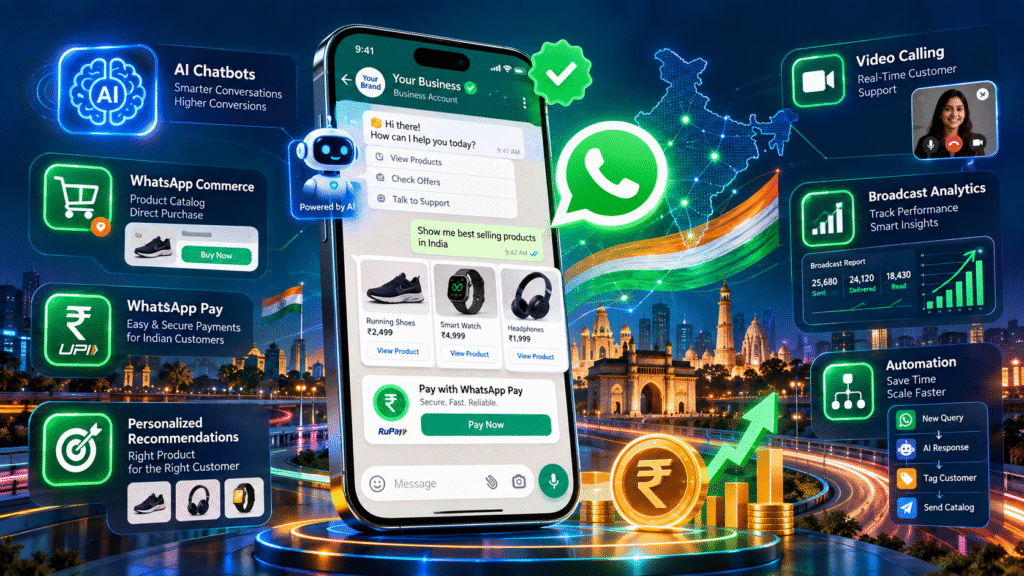
WhatsApp is now the primary customer communication channel for businesses across India. It is where leads are captured and nurtured. Where orders are placed and confirmed. Where customer support happens in real time. Where promotional campaigns reach millions of opted-in customers simultaneously. Where businesses automate entire sales processes through intelligent chatbots. Where payments are made. And where the relationship between Indian businesses and their customers is increasingly being defined.
India has over 500 million active WhatsApp users — more than any other country in the world. WhatsApp penetration across age groups, income levels, and geographies in India is unmatched by any other communication platform. This reach combined with Meta’s increasingly sophisticated WhatsApp Business API capabilities is creating a marketing ecosystem that is evolving faster in India than anywhere else on earth.
For business owners in Bhubaneswar and across India the question is not whether WhatsApp will be central to business communication and marketing in the coming years. It absolutely will be. The question is whether your business will be at the forefront of that evolution — or scrambling to catch up after your competitors have already seized the advantage.
This complete guide covers the most important trends shaping the future of WhatsApp marketing in India in 2026 and beyond — what is changing, why it matters for your specific business, and exactly what you should be doing right now to position yourself ahead of the curve.
The Current State of WhatsApp Marketing in India — A Baseline
Before we look at where WhatsApp marketing in India is going it helps to understand where it is right now — because the pace of change becomes clearer against this baseline.
As of 2026 WhatsApp marketing in India encompasses three distinct levels of sophistication:
Level 1 — Basic WhatsApp Business App users. The vast majority of Indian businesses — small shops, individual service providers, home-based businesses — are using the free WhatsApp Business App for manual one-on-one customer communication. They respond to enquiries individually, send product photos on request, and use basic auto-replies. This is the ground floor of WhatsApp business communication.
Level 2 — WhatsApp Business API early adopters. A growing number of more sophisticated businesses in cities like Bhubaneswar, Hyderabad, Mumbai, and Bangalore have implemented WhatsApp Business API — using automated chatbots, broadcast campaigns, and multi-agent team inboxes to handle significantly higher volumes of customer communication. These businesses have a significant competitive advantage over Level 1 businesses.
Level 3 — Advanced WhatsApp ecosystem builders. A small but rapidly growing number of Indian businesses are building comprehensive WhatsApp marketing ecosystems — integrating WhatsApp API with CRM systems, using advanced AI-powered chatbots, running sophisticated broadcast segmentation, leveraging WhatsApp Commerce features, and measuring WhatsApp ROI with the same rigor they apply to Google Ads or email marketing. This is where the frontier of WhatsApp marketing in India currently exists.
The trends we are about to discuss will move the entire Indian WhatsApp marketing landscape significantly — bringing capabilities that are currently Level 3 innovations into mainstream Level 2 practice, and creating entirely new Level 3 possibilities that do not yet exist at scale.
Trend 1 — AI-Powered WhatsApp Chatbots Will Become the Standard
In 2026 most WhatsApp chatbots used by Indian businesses are rule-based — they follow predetermined conversation trees and respond to specific keywords or button selections. They are effective for simple, structured interactions like appointment booking and FAQ handling but they break down when customers deviate from the expected flow or phrase their questions in unexpected ways.
The next evolution — already beginning in India and accelerating rapidly through 2026 and beyond — is the integration of large language models and generative AI into WhatsApp chatbots. The result is AI-powered WhatsApp chatbots that can:
Understand natural language conversations — A customer can type “I want to know about your cheapest 2BHK option near Infocity and whether there is parking” and the AI chatbot understands the entire compound query and responds specifically to all three elements — price, location, and parking — rather than routing to a generic FAQ.
Maintain context across long conversations — Advanced AI chatbots remember what was said earlier in the conversation and use that context to personalize subsequent responses. If a customer mentioned they have a budget of Rs. 60 lakhs in message 3 the AI chatbot references this when presenting options in message 15 — creating a genuinely personalized experience.
Handle objections intelligently — When a customer says “the price seems too high” or “I need to think about it” an AI chatbot can respond to the specific concern with relevant information, social proof, or alternative options — rather than simply routing to a human agent or ending the conversation.
Generate personalized content — AI chatbots can generate unique, personalized responses based on the customer’s specific situation rather than selecting from a library of pre-written responses — making every conversation feel genuinely individual rather than automated.
Learn and improve continuously — Unlike rule-based chatbots that require manual updates to improve AI chatbots learn from every conversation — getting better at handling edge cases, improving their understanding of customer intent, and optimizing their responses for conversion outcomes over time.
What This Means for Indian Businesses
The businesses that will win in India’s WhatsApp marketing landscape over the next 2 to 3 years are those that begin moving from rule-based to AI-powered chatbot infrastructure now. The transition requires investment in both technology and conversation design — but the competitive advantage delivered by a genuinely intelligent WhatsApp chatbot over a simple rule-based one is enormous.
For businesses in Bhubaneswar this means evaluating your WhatsApp Business Solution Provider’s AI chatbot capabilities and beginning to map the conversation scenarios where AI understanding would dramatically improve your customer experience and conversion rates.
Trend 2 — WhatsApp Commerce Will Transform Indian Retail and E-Commerce
One of the most significant developments in WhatsApp’s evolution as a business platform is the emergence of WhatsApp Commerce — the ability for customers to browse products, add to cart, and complete purchases directly within a WhatsApp conversation without ever leaving the app.
WhatsApp Commerce in India is evolving through several capabilities:
WhatsApp Product Catalogues — Businesses can create product catalogues visible directly on their WhatsApp Business Profile — allowing customers to browse products, view pricing, and share specific products with friends within WhatsApp. This is already available to many Indian businesses through the WhatsApp Business App and is becoming increasingly sophisticated through the API.
In-Chat Shopping — Businesses using WhatsApp Business API can send product messages with images, descriptions, and prices directly in conversations — allowing customers to browse and select products within the WhatsApp chat interface itself. The entire consideration and selection process happens inside WhatsApp.
WhatsApp Pay for In-Chat Purchases — WhatsApp Pay — India’s UPI-based payment system built into WhatsApp — allows customers to complete purchases directly within WhatsApp conversations. A customer can browse products, ask questions, select items, and pay — all without leaving the app they are already using.
Abandoned Cart Recovery — Businesses can identify when a customer has browsed their WhatsApp catalogue or added items to a cart but not completed purchase and automatically send a personalized WhatsApp message recovering the potential sale. Given WhatsApp’s 90 plus percent open rates this recovery mechanism significantly outperforms email-based cart recovery.
What This Means for Indian Businesses
WhatsApp Commerce represents a fundamental shift in how Indian consumers can buy from businesses — reducing the friction of the purchase journey to its absolute minimum. The implications are particularly significant for:
Retail businesses in Bhubaneswar — Small retailers, boutique stores, and specialty shops that currently take orders through personal WhatsApp messages manually can build systematized, scalable WhatsApp Commerce flows that handle order collection, payment, and fulfillment coordination automatically.
Food and beverage businesses — Restaurants, cloud kitchens, and caterers can enable direct ordering through WhatsApp — reducing dependence on third-party delivery platforms and their associated commission costs.
D2C brands — Direct-to-consumer brands selling across India can build WhatsApp as a primary sales channel — reaching customers where they already spend their time and completing sales without the friction of app downloads or website navigation.
For businesses not yet thinking about WhatsApp as a commerce channel the window to establish this capability before competitors is narrowing.
Trend 3 — Click to WhatsApp Ads Will Dominate Indian Digital Advertising
Click to WhatsApp Ads — Facebook and Instagram advertisements that open a direct WhatsApp conversation when tapped rather than directing to a website or landing page — are the fastest-growing ad format in India and are rapidly becoming the default lead generation mechanism for Indian businesses across every sector.
The growth of Click to WhatsApp Ads in India reflects a fundamental truth about Indian consumer behavior: Indian consumers are significantly more willing to initiate a WhatsApp conversation than to fill out a website form. The intimacy, speed, and familiarity of WhatsApp communication makes it the preferred mode of first contact with businesses across virtually all demographics and income levels.
The statistics from Click to WhatsApp campaigns running across Indian businesses tell the story clearly. Click to WhatsApp Ads consistently deliver lower cost per lead, higher lead quality, and better conversion rates than equivalent landing page campaigns — because the immediate, conversational nature of WhatsApp creates a fundamentally different and more engaging initial interaction.
The Evolution of Click to WhatsApp Ads in India
Through 2026 and beyond Click to WhatsApp Ads are evolving beyond simple conversation starters into sophisticated marketing funnels:
Automated welcome sequences — When a customer taps a Click to WhatsApp Ad they immediately receive an automated, personalized welcome sequence through WhatsApp Business API — delivering product information, qualifying questions, and a clear next step — all without any human involvement.
Retargeting integration — Businesses are building sophisticated retargeting flows where customers who clicked a WhatsApp Ad but did not convert receive specific follow-up ads on Facebook and Instagram — maintaining presence through the consideration period.
AI-powered immediate qualification — AI chatbots immediately qualify WhatsApp leads arriving from ads — collecting budget, timeline, and requirement information — so that by the time a human sales person gets involved the lead is already fully profiled and the sales conversation can focus entirely on closing.
Measurement and attribution — Meta is improving its ability to track the complete customer journey from Click to WhatsApp Ad through WhatsApp conversation to conversion — giving Indian businesses increasingly accurate data on the true ROI of their WhatsApp advertising investment.
What This Means for Indian Businesses
If you are currently running Facebook or Instagram Ads that direct to a landing page or website form — test Click to WhatsApp Ads with the same audience and budget immediately. For the vast majority of Indian businesses in consumer-facing categories the Click to WhatsApp format will outperform traditional destination ads on cost per lead and lead quality.
For businesses in Bhubaneswar this represents one of the most impactful and immediately actionable changes available in digital marketing right now. The combination of Click to WhatsApp Ads driving leads into WhatsApp Business API automation is the most powerful lead generation stack available to most Indian businesses in 2026.
Trend 4 — WhatsApp Pay Will Reshape Indian Business Commerce
WhatsApp Pay — built on India’s Unified Payments Interface — is the native payment capability integrated directly into WhatsApp. After a gradual rollout that navigated significant regulatory approvals WhatsApp Pay is now available to hundreds of millions of Indian users and is being actively promoted by Meta as a core WhatsApp business capability.
The implications for Indian businesses are profound. When payment capability is built directly into the messaging platform that handles lead generation, customer communication, and sales conversations the entire commerce journey — from first awareness to completed purchase — can happen within a single WhatsApp thread.
Current WhatsApp Pay Capabilities in India
Peer-to-peer payments — Individuals can send and receive money through WhatsApp Pay using UPI — directly competing with PhonePe, Google Pay, and Paytm for consumer payment behavior.
Business payments — Businesses can request payments from customers directly within WhatsApp conversations. A customer who enquires about a service, receives a quote, and decides to proceed can pay the advance or full amount directly within the same WhatsApp conversation — no separate payment link, no redirection to a payment gateway, no friction.
Payment links in broadcasts — WhatsApp Business API users can send broadcast messages that include payment links — enabling customers to pay for renewals, memberships, event tickets, or products directly from a broadcast message.
Future WhatsApp Pay Developments for Indian Businesses
Through 2026 and beyond WhatsApp Pay is expected to evolve significantly for Indian businesses:
Seamless checkout integration — The ability for customers to complete a purchase including payment within a WhatsApp Commerce flow — browsing products in the WhatsApp catalogue, adding to cart, and paying through WhatsApp Pay — all within one uninterrupted WhatsApp conversation.
Subscription billing — Businesses offering subscription services will be able to set up recurring payment authorizations through WhatsApp Pay — automatically charging customers at renewal intervals with WhatsApp notifications confirming each transaction.
Business financial services — Meta has indicated interest in expanding WhatsApp’s financial services capabilities for Indian businesses — potentially including business loans, working capital financing, and other financial products distributed through the WhatsApp platform.
What This Means for Indian Businesses
WhatsApp Pay represents the completion of the WhatsApp commerce cycle — making WhatsApp a complete end-to-end business platform from marketing and lead generation through sales and customer service to payment collection.
For businesses in Bhubaneswar this means that the WhatsApp Business API infrastructure you build now — your chatbots, your broadcast capabilities, your customer database — is also the foundation for WhatsApp commerce and payment capabilities that will become increasingly valuable as Meta continues developing these features.
Trend 5 — Hyper-Personalization Through WhatsApp API Will Separate Market Leaders
In the early days of WhatsApp business marketing the threshold for being impressive was simply responding to customers on WhatsApp at all. Then it became sending automated responses. Then building chatbots. Then running broadcast campaigns.
In 2026 and beyond the threshold is moving to hyper-personalization — the ability to deliver WhatsApp communications that feel genuinely individual to each customer based on their specific history, preferences, behavior, and stage in the customer journey.
Hyper-personalization through WhatsApp Business API is enabled by the integration of WhatsApp with sophisticated CRM systems and customer data platforms that allow businesses to trigger specific WhatsApp communications based on precise customer behavior signals:
Purchase behavior triggers — A customer who purchased Product A receives a WhatsApp message 30 days later recommending the complementary Product B based on their purchase history. A customer who has purchased 3 times receives a loyalty reward message that acknowledges their specific purchase history.
Browse abandonment — A customer who visited your property listing page 4 times in the last week but did not enquire receives a personalized WhatsApp message acknowledging their repeated interest and offering a specific incentive to schedule a site visit.
Lifecycle stage triggers — A customer who has not purchased in 90 days receives a personalized re-engagement WhatsApp message with an offer specific to the products they previously bought. A customer approaching the anniversary of their previous purchase receives a relevant renewal or upgrade offer.
Event-based triggers — A customer whose birthday is tomorrow receives a personalized WhatsApp birthday message with a special offer. A customer who registered for your webinar receives a personalized reminder with their name and specific session details.
Real-time behavior integration — Advanced implementations integrate WhatsApp API with real-time website behavior data — triggering personalized WhatsApp messages based on specific page visits, time spent on specific content, or specific actions taken on the website.
What This Means for Indian Businesses
The businesses in India that will dominate their markets through WhatsApp marketing in the coming years are those that move beyond broadcast marketing — the same message to everyone — toward truly personalized WhatsApp communication that makes each customer feel like they are receiving a message written specifically for them.
This requires three components working together: a WhatsApp Business API setup with robust automation capabilities, a CRM or customer data platform that captures and organizes customer behavior data, and a communications strategy that maps specific customer behaviors to specific WhatsApp message triggers.
For businesses in Bhubaneswar beginning to think about this level of WhatsApp personalization the starting point is ensuring you are collecting customer data systematically — recording every WhatsApp interaction, tracking website behavior through the Meta Pixel, and organizing customer information in a structured CRM that can eventually be used to drive personalized communications.
Trend 6 — WhatsApp Will Become a Customer Service Standard in India
Customer service in India is undergoing a fundamental transformation driven by WhatsApp. The traditional customer service channels — phone calls and email — are being displaced by WhatsApp for an increasing proportion of customer service interactions across virtually every industry.
The drivers of this shift are straightforward:
Indian consumers prefer WhatsApp because it is convenient — they can send a message whenever they want, without waiting on hold, and continue with their day while waiting for a response. They can share photos of a defective product or a delivery discrepancy instantly and visually. They have a complete record of every interaction in their WhatsApp chat history.
Businesses benefit because WhatsApp customer service is more efficient than phone support — agents can handle multiple WhatsApp conversations simultaneously in a way they cannot with phone calls. Chatbots can handle a significant proportion of routine queries automatically — reducing the volume that reaches human agents. And the asynchronous nature of WhatsApp communication reduces the urgency pressure that makes phone-based customer service so stressful.
The Customer Service WhatsApp Capabilities Emerging in India
Automated resolution flows — Chatbots that handle complete resolution of common customer service scenarios without human involvement — order status checks, appointment rescheduling, basic troubleshooting, refund initiation — significantly reducing the workload on human customer service teams.
Escalation with context transfer — When a customer service chatbot determines a query requires human attention it transfers the conversation to a human agent with full context — the customer’s account history, the complete conversation so far, and the specific issue — so the agent can provide immediate, informed assistance without asking the customer to repeat themselves.
Proactive service communications — Businesses using WhatsApp for proactive service notifications — delivery updates, appointment reminders, maintenance alerts, subscription renewal notices — dramatically reduce inbound service enquiries because customers already have the information they would otherwise have called to ask for.
Customer satisfaction measurement — Automated CSAT surveys delivered through WhatsApp immediately after a service interaction — a single quick-reply button rating request — capture satisfaction data at far higher rates than traditional email surveys, giving businesses real-time insight into service quality.
What This Means for Indian Businesses
Customer service is increasingly a competitive differentiator in India. Businesses that provide fast, convenient, WhatsApp-based customer service build stronger customer relationships, generate better reviews, create more loyal customers, and benefit from more word-of-mouth referrals than those still relying on phone and email support.
For businesses in Bhubaneswar this means thinking about WhatsApp not just as a marketing and lead generation tool but as a comprehensive customer communication platform that handles the entire customer relationship — from first enquiry through purchase, through service and support, through retention and repeat purchase.
Trend 7 — WhatsApp Marketing Compliance and Quality Will Be Enforced More Strictly
As WhatsApp’s role in Indian business communication expands Meta is simultaneously tightening the policies, quality requirements, and enforcement mechanisms that govern how businesses can use the platform.
This trend is critically important for Indian businesses to understand because the consequences of non-compliance are severe — including permanent banning of your WhatsApp Business number — and the bar for what constitutes acceptable WhatsApp marketing practice is rising continuously.
What Meta’s Quality Enforcement Means in Practice
Message quality ratings — Every WhatsApp Business API account is assigned a message quality rating based on user feedback signals — whether recipients are blocking your messages, reporting them as spam, or responding negatively. A declining quality rating restricts your messaging capacity and ultimately suspends your account if it falls below minimum thresholds.
Stricter template approval — Meta’s template approval process for marketing messages is becoming more rigorous — rejecting templates that are purely promotional without genuine value, templates that use manipulative urgency claims, and templates that violate specific content policies.
Opt-in enforcement — Meta’s enforcement of the requirement that all broadcast recipients have explicitly opted in to receive WhatsApp communications from your business is becoming increasingly strict. Businesses that purchase phone number lists and blast WhatsApp messages to people who have not opted in face immediate account suspension.
Rate limiting for new accounts — New WhatsApp Business API numbers start with strict messaging rate limits — 1,000 unique business-initiated conversations per day — and must build a positive messaging history to unlock higher tiers. Trying to scale too quickly without establishing quality signals first can result in permanent tier limitations.
What This Means for Indian Businesses
The trend toward stricter WhatsApp marketing compliance in India is fundamentally good for businesses that are using the platform legitimately — because it reduces the spam and poor-quality messaging that degrades the WhatsApp experience for Indian consumers and makes them less responsive to business communications overall.
But it means that businesses in India that cut corners — buying phone number lists, sending unsolicited broadcasts, using misleading template content — face increasingly severe and rapidly applied consequences.
For businesses in Bhubaneswar the compliance implication is clear: build your WhatsApp marketing practice on legitimate, high-quality foundations from the start. Collect opt-ins genuinely and document them. Create message templates that provide genuine value. Monitor your message quality rating and respond immediately to any decline. These are not just ethical requirements — they are the practical requirements for maintaining WhatsApp API access as enforcement tightens.
Trend 8 — WhatsApp Video and Voice Features Will Open New Marketing Channels
WhatsApp is expanding beyond text and image messaging into richer communication formats — and these expansions are creating new opportunities for Indian businesses to communicate with customers in more engaging, personal, and effective ways.
WhatsApp Video Calls for Business
WhatsApp video calls are already used by millions of Indian consumers daily. The integration of video calling capabilities into WhatsApp Business API creates opportunities for businesses to offer:
Video consultations — Healthcare providers, financial advisors, legal professionals, and other consultation-based businesses in Bhubaneswar can offer WhatsApp video consultations — removing the need for in-person visits for many types of advisory interactions.
Product demonstrations — Retail businesses, automotive dealerships, and real estate developers can offer live WhatsApp video product demonstrations — a salesperson walking through an apartment or demonstrating a car feature live through WhatsApp video.
Video customer support — For technical or visual customer service issues — a broken product, an installation query, a design decision — WhatsApp video support allows agents to see the customer’s actual situation and provide far more effective assistance.
WhatsApp Voice Notes for Business Communication
Voice notes — already widely used by Indian WhatsApp users in personal communication — are increasingly being used by businesses for more personal and engaging business communication:
Personalized audio responses — A sales consultant sending a personalized voice note response to a customer enquiry creates a more human and trustworthy impression than a text message — particularly effective for high-value sales processes in real estate, automotive, and professional services.
Audio broadcast content — Businesses sending valuable audio content to their WhatsApp database — a weekly market insight from a real estate agency, a health tip from a clinic, a business advice note from a digital marketing agency — create engagement and authority in a format that differentiates from standard text broadcasts.
What This Means for Indian Businesses
The expansion of WhatsApp into video and voice creates new dimensions for business communication that most Indian businesses have not yet begun to explore. The businesses that experiment with video consultations, personalized voice responses, and audio content marketing now will be ahead of the curve when these capabilities become mainstream WhatsApp business tools.
Trend 9 — WhatsApp Marketing Measurement and Attribution Will Mature
One of the historical limitations of WhatsApp as a marketing channel for Indian businesses has been the difficulty of measuring its true business impact — connecting WhatsApp interactions to downstream business outcomes like purchases, bookings, and revenue.
This is changing rapidly through 2026 as measurement and attribution capabilities for WhatsApp Business API mature:
Conversion API integration — Meta’s Conversion API allows WhatsApp interactions to be tracked alongside website events — creating a more complete picture of how WhatsApp touchpoints contribute to conversions across the full customer journey.
CRM attribution — Sophisticated CRM integrations are enabling businesses to track which WhatsApp broadcasts, sequences, and conversations led to specific deals closing — creating clear attribution data that allows WhatsApp marketing ROI to be calculated with the same precision as Google Ads or email campaigns.
Cohort analysis — Businesses are beginning to analyze the long-term value of customers acquired or retained through WhatsApp marketing — comparing lifetime customer value, repurchase rates, and referral behavior between WhatsApp-engaged and non-WhatsApp-engaged customer cohorts.
WhatsApp funnel analytics — BSP platforms are developing increasingly sophisticated analytics that track the full WhatsApp marketing funnel — from broadcast message delivery through chatbot conversation through lead qualification through human follow-up to conversion — allowing businesses to identify exactly where their WhatsApp funnel is most and least effective.
What This Means for Indian Businesses
As WhatsApp marketing measurement matures the businesses that have been investing in WhatsApp Business API will be able to demonstrate increasingly clear ROI — accelerating investment and creating larger competitive advantages over those who have not yet adopted the platform.
For businesses in Bhubaneswar beginning their WhatsApp API journey now the measurement setup — ensuring your BSP platform integrates with your CRM and tracks conversion events properly — should be a priority from the very start. The data you collect from your first WhatsApp campaigns will become increasingly valuable as your analytics capabilities mature.
Trend 10 — WhatsApp Will Become the Primary Customer Retention Channel in India
Perhaps the most significant long-term trend in WhatsApp marketing for Indian businesses is the shift from WhatsApp as a lead generation tool to WhatsApp as the primary customer retention and lifetime value maximization channel.
In the current state of WhatsApp marketing most Indian businesses focus on using WhatsApp to convert new leads — responding to enquiries, qualifying prospects, booking appointments. This is valuable but it captures only a fraction of WhatsApp’s business potential.
The future — and for the most sophisticated Indian businesses the present — is using WhatsApp as the primary channel for building long-term customer relationships that maximize lifetime value:
Loyalty program delivery — WhatsApp-based loyalty programs that track points, deliver rewards, and communicate exclusive member benefits through personalized WhatsApp messages — without requiring customers to download a separate app.
Post-purchase nurture sequences — Systematic WhatsApp communication journeys that guide customers through the post-purchase experience — product education, usage tips, satisfaction follow-up, review requests, and natural cross-sell and upsell opportunities — at precisely timed intervals.
Renewal and reactivation programs — Automated WhatsApp sequences that identify customers approaching renewal dates or showing signs of churn and deliver targeted, personalized retention messages before the relationship deteriorates.
Community building — WhatsApp Groups and WhatsApp Channels used to build genuine communities of engaged customers — creating the kind of brand loyalty and peer recommendation behavior that no advertising can buy.
Referral programs — Systematic WhatsApp-based referral programs that make it easy for satisfied customers to recommend your business to friends and family — with automated tracking, reward delivery, and follow-up.
What This Means for Indian Businesses
The businesses that will extract the most long-term value from WhatsApp marketing in India are those that think about it as a relationship platform — not just a lead generation channel. Every customer you bring into your WhatsApp ecosystem is a lifetime relationship opportunity. The sophistication with which you manage that relationship will determine whether they buy from you once or ten times — and whether they refer one friend or ten.
For businesses in Bhubaneswar this means thinking about your WhatsApp customer database as one of your most valuable business assets — worthy of the same care and investment as your physical premises, your team, and your product quality.
How to Position Your Business for the Future of WhatsApp Marketing in India
Understanding these trends is valuable. Acting on them is what actually creates competitive advantage. Here is a practical roadmap for positioning your business at the forefront of WhatsApp marketing in India in 2026:
If You Are Still Using the WhatsApp Business App
Your immediate priority is getting WhatsApp Business API set up. The gap between what the Business App can deliver and what the API enables is only growing larger as Meta continues developing the platform. Every month you delay API adoption is another month your competitors with API access are building lead response, nurturing, and retention capabilities you cannot match.
If You Have Basic WhatsApp Business API
Your priorities are expanding your capabilities — building more sophisticated chatbot flows, integrating with your CRM, beginning to use broadcast segmentation, and setting up proper measurement and attribution. The basic API is a foundation. The competitive advantage comes from what you build on top of it.
If You Have Advanced WhatsApp API Implementation
Your priorities are incorporating AI capabilities into your chatbot infrastructure, beginning to test WhatsApp Commerce features, developing hyper-personalization through CRM integration, and building the WhatsApp-based customer retention programs that maximize lifetime value. You are in the best position to capture the leading edge of WhatsApp marketing evolution — the question is whether you are actively investing in that position.
How Prominds Digital Is Preparing BBSR and Odisha Businesses for the Future of WhatsApp Marketing
At Prominds Digital we are not just implementing today’s WhatsApp marketing capabilities for businesses in Bhubaneswar — we are actively preparing our clients for the trends that will define WhatsApp marketing in India over the next 2 to 3 years.
Our WhatsApp Business API implementations are built with future scalability in mind — choosing BSP platforms with strong AI integration roadmaps, building chatbot architectures that can incorporate AI language models as they become available, and setting up CRM integrations that will support increasingly sophisticated personalization.
We stay at the forefront of Meta’s WhatsApp Business product developments — participating in beta programs, monitoring Meta’s product releases, and continuously updating our implementation recommendations based on new capabilities.
And we help our BBSR clients build the compliance foundations — genuine opt-in collection, high-quality messaging practices, and proactive quality rating monitoring — that will ensure their WhatsApp marketing capabilities are protected as Meta’s enforcement tightens.
The businesses that will dominate their markets through WhatsApp marketing in Bhubaneswar in 2027 and 2028 are the ones making smart investments in WhatsApp infrastructure and capabilities today. We help those businesses make those investments wisely.
Frequently Asked Questions
Q: Is WhatsApp marketing becoming more or less effective for Indian businesses?
Significantly more effective — for businesses using it correctly. As WhatsApp’s capabilities expand through Commerce, Pay, AI chatbots, and improved measurement the platform’s potential for Indian businesses is growing rapidly. What is becoming less effective is low-quality, non-compliant WhatsApp marketing — spam broadcasts, purchased lists, and poor-quality messaging — as Meta’s enforcement tightens. For businesses using WhatsApp marketing legitimately with genuine opt-ins and valuable content the trajectory is strongly positive.
Q: When will WhatsApp Pay become significant for Indian businesses?
WhatsApp Pay is already available to Indian users and businesses but its adoption is still building relative to established UPI apps like PhonePe and Google Pay. Through 2026 and 2027 as Meta continues promoting and developing the feature expect WhatsApp Pay adoption to accelerate significantly — particularly as WhatsApp Commerce flows make in-chat payment the most frictionless option for completing purchases within WhatsApp conversations.
Q: How should businesses in Bhubaneswar prepare for AI-powered WhatsApp chatbots?
Start by documenting your most important customer conversations — the common enquiries, the frequent objections, the typical qualification questions, the standard follow-up sequences. This documentation becomes the training data and conversation design foundation for AI chatbot implementation. Also evaluate your current WhatsApp Business Solution Provider’s AI chatbot capabilities and roadmap — choosing a provider with strong AI integration plans is an important forward-looking infrastructure decision.
Q: What is the biggest WhatsApp marketing mistake Indian businesses are making in 2026?
Without question the biggest mistake is messaging people who have not explicitly opted in — either buying phone number lists or adding contacts to broadcast lists without their consent. This creates spam reports that damage message quality ratings, risks permanent account suspension, damages brand reputation, and violates both Meta’s policies and Indian data privacy principles. Building a legitimate, consent-based WhatsApp contact database takes longer but delivers dramatically better results and zero compliance risk.
Q: How many Indian businesses are currently using WhatsApp Business API?
Precise figures are not publicly available but Meta has indicated that millions of businesses globally use WhatsApp Business API and India is one of the largest markets. In Bhubaneswar specifically the adoption of formal WhatsApp Business API is still relatively early — giving businesses that implement now a significant first-mover advantage before the market becomes saturated.
Q: Can Prominds Digital help my Bhubaneswar business prepare for the future of WhatsApp marketing?
Yes absolutely. We offer WhatsApp Business API implementation, chatbot design, broadcast campaign management, CRM integration, and ongoing optimization for businesses across Bhubaneswar and Odisha. We also actively advise our clients on emerging WhatsApp capabilities and help them plan for future developments. Contact us for a free WhatsApp marketing consultation.
The Future of WhatsApp Marketing in India Is Being Written Right Now
The trends described in this guide are not distant possibilities — they are active developments happening in India’s WhatsApp ecosystem right now. AI chatbots are being deployed by leading Indian businesses today. WhatsApp Commerce is processing real transactions today. Click to WhatsApp Ads are generating leads for forward-thinking businesses today. WhatsApp Pay is processing real payments today.
The gap between businesses at the frontier of WhatsApp marketing in India and those still manually typing responses on the WhatsApp Business App is growing wider every month. And the compounding effect of early investment in WhatsApp infrastructure — a growing opt-in database, an improving AI chatbot, a maturing broadcast segmentation strategy, a deepening CRM integration — means that the advantage of early adopters grows rather than diminishes over time.
For businesses in Bhubaneswar and across India the strategic question is not whether to invest seriously in WhatsApp marketing. The trends make the answer to that question undeniably clear. The question is how quickly and how well — and whether your business will be a leader or a follower in the WhatsApp marketing evolution that is reshaping Indian business communication in 2026 and beyond.
Get in touch with Prominds Digital today for a free WhatsApp marketing consultation and find out exactly how to position your business at the forefront of these trends.
📞 Call us: 9090090150
📧 Email: hello@prominds.digital
🌐 Visit: prominds.digital
📍 A-141, 2nd Floor, Saheed Nagar, Bhubaneswar, Odisha
Prominds Digital — WhatsApp Business API and WhatsApp Marketing Specialists for Businesses in Bhubaneswar and across India. Chatbots. Broadcasts. Commerce. Automation. Your Growth. Our Mission.