
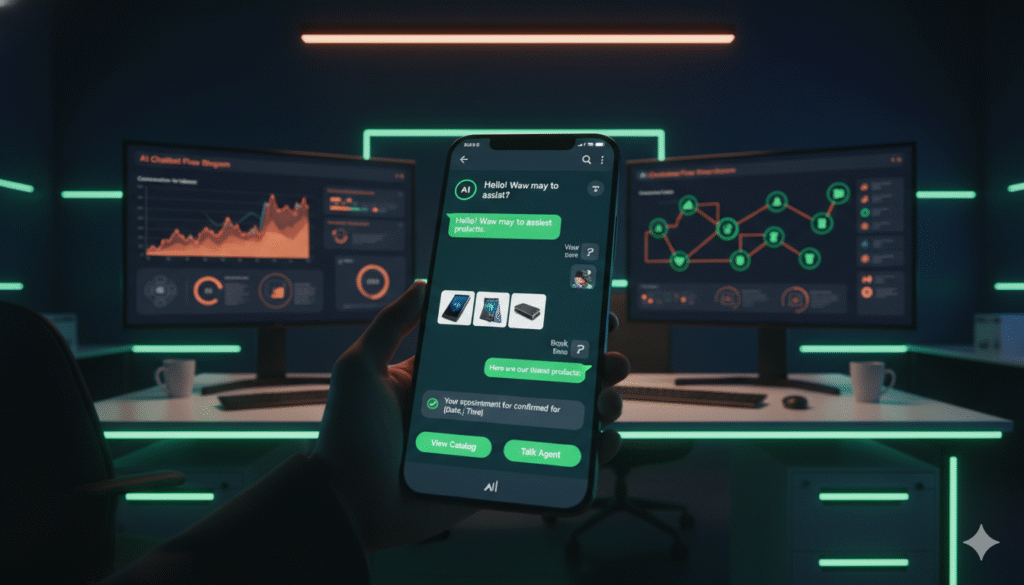
WhatsApp AI Chatbots in 2026: How Indian Businesses Are Using Them to Scale
Picture this. It is 11 PM on a Saturday night in Bhubaneswar. Your office is closed. Your entire team is offline. But somewhere across the city a potential customer has just seen your Instagram ad, visited your website, and sent a message to your WhatsApp number asking about your services.
Without a WhatsApp AI chatbot, that message sits unread until Monday morning. By then the customer has already spoken to three competitors and made their decision.
With a WhatsApp AI chatbot, something very different happens. Within 3 seconds the customer receives a personalized response. The chatbot greets them by name, asks what they are looking for, collects their requirements, answers their questions, shares your service brochure, and books a consultation call — all automatically, all intelligently, all without a single human being involved.
By Monday morning your team does not have a cold lead to chase. They have a warm, qualified prospect who already knows what you offer, has received your proposal, and is expecting your call.
This is not a vision of the future. This is exactly what WhatsApp AI chatbots are doing for businesses across India right now in 2026. And the businesses using them are scaling faster, converting more leads, and delivering better customer experiences than those still relying entirely on manual communication.
In this blog we cover everything you need to know about WhatsApp AI chatbots — what they are, how they work, how Indian businesses across different industries are using them, and how your business can get started.
What Is a WhatsApp AI Chatbot?
A WhatsApp AI chatbot is an automated conversation program that runs on your WhatsApp Business API number and interacts with customers in real time using artificial intelligence and pre-built conversation flows.
Unlike basic rule-based chatbots that only respond to exact keyword matches, modern WhatsApp AI chatbots in 2026 use natural language processing — the ability to understand what a person means even when they phrase a question in different ways — to deliver genuinely helpful, contextually relevant responses that feel natural rather than robotic.
When a customer sends a message to your WhatsApp number, the AI chatbot reads the message, understands the intent behind it, and responds with the most appropriate reply — whether that is answering a question, collecting information, sending a document, booking an appointment, or routing the conversation to a human agent when needed.
The chatbot runs 24 hours a day, 7 days a week, handling as many simultaneous conversations as needed without any additional cost or staffing. A single WhatsApp AI chatbot can handle hundreds of customer conversations at the same time — something that would require a large team of human agents to match.
Why WhatsApp Is the Perfect Platform for AI Chatbots in India
India is the largest WhatsApp market in the world with over 500 million active users. WhatsApp is not just an app Indians use — it is the primary way most Indians communicate with everyone from family members to businesses they buy from.
This makes WhatsApp the ideal platform for AI chatbot deployment for any business serving Indian customers. Here is why:
Customers are already there. You do not need to convince your customers to download a new app or visit a new platform. They are already on WhatsApp every single day. Deploying a chatbot on WhatsApp means meeting customers where they already are.
WhatsApp messages get read. WhatsApp has a 95% message open rate. When your chatbot sends a follow-up message, a reminder, or a piece of information, it will almost certainly be seen — unlike emails that get ignored or SMS messages that feel intrusive.
WhatsApp conversations feel personal. The conversational format of WhatsApp makes chatbot interactions feel more natural and personal than web chat widgets or email automation. Customers in India are comfortable sharing information, asking questions, and making decisions through WhatsApp conversations.
Rich media support. WhatsApp supports text, images, videos, documents, voice messages, location sharing, and interactive buttons — giving AI chatbots a rich toolkit to deliver genuinely helpful, engaging responses rather than plain text only.
How WhatsApp AI Chatbots Work in 2026
Modern WhatsApp AI chatbots in 2026 operate on several layers of intelligence that make them far more capable than earlier generations of chatbots:
Natural Language Understanding The chatbot reads incoming messages and identifies the customer’s intent — what they are trying to achieve — even when the phrasing varies. A customer asking “how much does it cost,” “what are your rates,” “can you tell me the price,” or “kitna lagega” is expressing the same intent in different ways. The AI understands all of these as a pricing enquiry and responds with your pricing information.
Context Awareness Modern AI chatbots maintain context throughout a conversation. If a customer mentions they are looking for a 2BHK flat in Patia earlier in the conversation, the chatbot remembers this when answering subsequent questions and tailors its responses accordingly — rather than treating each message as a standalone interaction.
Conditional Logic Flows Beyond AI understanding, chatbots use conditional logic to guide conversations toward specific outcomes. Based on a customer’s answers the chatbot branches the conversation in different directions — showing different information, asking different follow-up questions, or routing to different team members based on what the customer has revealed about themselves.
Seamless Human Handover When a conversation reaches a point that requires human judgment — a complex negotiation, a complaint resolution, or a high-value sales conversation — the AI chatbot smoothly hands over to a human agent, transferring all conversation context so the agent can pick up exactly where the chatbot left off without the customer needing to repeat themselves.
Continuous Learning AI chatbots improve over time. As they handle more conversations they learn which responses work best, which conversation flows convert most effectively, and where customers most commonly drop off or express frustration — allowing ongoing optimization of their performance.
How Indian Businesses Are Using WhatsApp AI Chatbots to Scale in 2026
Here are the specific, practical ways businesses across India and Bhubaneswar are deploying WhatsApp AI chatbots right now:
Real Estate — Qualifying and Nurturing Hundreds of Leads Automatically
Real estate is one of the industries seeing the most dramatic impact from WhatsApp AI chatbots in India. A typical real estate developer in Bhubaneswar running Facebook and Google Ads might receive 100 to 300 new leads per week during a project launch. Managing this volume manually — calling every lead, answering the same questions repeatedly, sending brochures individually — requires a large sales team and still results in slow response times that cost conversions.
With a WhatsApp AI chatbot a real estate developer can handle every single lead instantly and intelligently. When a new lead comes in through an ad or a website enquiry, the chatbot immediately sends a personalized welcome message, asks qualifying questions about budget, preferred configuration, and timeline, shares the project brochure and virtual tour link, answers FAQs about location, amenities, and payment plans, and schedules a site visit with the sales team — all automatically.
The sales team receives only pre-qualified leads who have already received all the basic information and are genuinely interested. Conversion rates improve dramatically because response times drop from hours to seconds and every lead gets equal attention regardless of when they enquire.
Healthcare — Appointment Booking and Patient Communication at Scale
Hospitals, clinics, and diagnostic centers across India are using WhatsApp AI chatbots to handle the enormous volume of patient communication that previously required dedicated front desk staff.
A multi-specialty clinic in Bhubaneswar might receive hundreds of appointment requests, prescription queries, and general health questions every week. A WhatsApp AI chatbot handles all of this — checking doctor availability and booking appointments, sending appointment confirmation and reminder messages, answering common questions about clinic timings, fees, and procedures, directing emergency cases to the appropriate contact immediately, and following up with patients after consultations to check recovery progress and schedule follow-up visits.
The result is dramatically reduced front desk workload, near-zero appointment no-show rates thanks to automated reminders, and a significantly improved patient experience because queries are answered instantly at any hour.
Education — Managing Peak Season Admission Enquiries
For coaching institutes, schools, and skill development centers in India, admission season creates a surge of enquiries that overwhelms staff and results in slow responses that cost enrollments.
A coaching institute in Bhubaneswar handling Class 11 and 12 science admissions might receive 500 to 1,000 WhatsApp enquiries in a two-week window. A WhatsApp AI chatbot instantly responds to every enquiry, shares course details, fee structures, and batch schedules, answers common questions about faculty, results, and study materials, collects student and parent details for follow-up, schedules counseling sessions with academic advisors, and sends automated reminders about application deadlines and fee payment.
Students and parents get instant, accurate information at any hour. The institute captures every lead regardless of when they enquire and converts a significantly higher percentage into enrolled students.
Automotive — Test Drive Bookings and Service Reminders on Autopilot
Automobile dealerships across India are using WhatsApp AI chatbots to automate the entire pre-sales and post-sales customer journey. When a prospective buyer enquires about a new car model, the chatbot shares detailed specifications, color options, and on-road pricing, books a test drive at a convenient time, sends confirmation and reminder messages before the test drive, follows up afterward to answer questions and invite the customer to visit the showroom, and coordinates with the finance team to share loan and EMI options.
Post-purchase the chatbot automatically sends service reminders at the appropriate intervals, wishes customers on their vehicle anniversary, informs them of new model launches and upgrade offers, and requests reviews and referrals from satisfied customers — maintaining an ongoing relationship that generates repeat service revenue and referrals.
E-Commerce and Retail — Order Management and Abandoned Cart Recovery
Retail businesses and e-commerce operators across India are using WhatsApp AI chatbots to dramatically reduce customer service workload while improving the shopping experience.
Order confirmation, shipping updates, and delivery notifications are sent automatically through WhatsApp — keeping customers informed without requiring any manual effort. Return and exchange requests are handled through a structured chatbot flow that collects all necessary information before routing to a human agent only when needed.
Abandoned cart recovery is one of the highest ROI applications for retail businesses. When a customer adds items to their cart but does not complete the purchase, the chatbot sends an automated WhatsApp message reminding them of the items, answering any questions they might have, and offering a limited-time incentive to complete the purchase. Abandoned cart recovery rates through WhatsApp significantly outperform email-based recovery because of WhatsApp’s dramatically higher open and response rates.
Digital Marketing Agencies — Lead Qualification and Client Onboarding
Digital marketing agencies in Bhubaneswar including Prominds Digital use WhatsApp AI chatbots to qualify new business enquiries efficiently and provide a superior client onboarding experience.
When a new business enquiry comes in through the website or an ad, the chatbot collects key information — business type, current marketing challenges, budget range, and goals — before routing qualified leads to the appropriate team member. This saves significant time that would otherwise be spent on discovery calls with unqualified prospects.
For new clients, onboarding checklists, document collection, and initial briefing processes can be partially automated through WhatsApp chatbot flows — reducing administrative burden and creating a smoother, more professional client experience from day one.
The Business Impact of WhatsApp AI Chatbots — Real Numbers
Here is the measurable impact that Indian businesses are seeing from WhatsApp AI chatbot deployment in 2026:
Response time drops from an average of 4 to 8 hours to under 30 seconds — a transformation that directly impacts lead conversion rates since speed of response is one of the strongest predictors of whether a lead converts.
Lead qualification efficiency improves dramatically. Instead of sales teams spending time on discovery calls with every single enquiry, they spend their time only on pre-qualified prospects that the chatbot has already screened. Sales productivity increases significantly without any additional hiring.
Customer satisfaction improves because queries are answered instantly and accurately at any hour. Customers no longer have to wait for business hours to get basic information about products, pricing, or availability.
Operational costs reduce because a single WhatsApp AI chatbot handles the communication volume that would otherwise require multiple customer service staff — particularly important for managing peak demand periods like admission season for educational institutes or project launch periods for real estate developers.
Lead capture rates improve because every enquiry — including those that come in at midnight on a Sunday — receives an immediate, professional response rather than going unanswered until the next business day.
What Makes a Great WhatsApp AI Chatbot for Indian Businesses
Not all WhatsApp chatbots deliver the same results. Here is what separates high-performing chatbots from poorly designed ones:
It understands Indian communication styles Indian customers often mix languages — sending messages in Hinglish or Odia-English combinations. A good WhatsApp AI chatbot for Indian businesses is trained to understand these natural communication patterns rather than requiring formally phrased English inputs.
It is conversational not robotic The best chatbots feel like helpful assistants rather than automated systems. They use natural, friendly language, acknowledge what the customer said before responding, and guide conversations in a way that feels intuitive rather than formulaic.
It knows when to hand over to a human A chatbot that tries to handle everything and never involves a human agent creates frustration when conversations require genuine judgment or empathy. The best chatbots recognize these situations quickly and make the handover to a human agent seamlessly.
It is optimized for conversion not just information A chatbot designed only to answer questions is less valuable than one designed to move conversations toward a specific outcome — booking an appointment, scheduling a consultation, completing a purchase, or collecting contact details for follow-up. Every conversation flow should have a clear conversion goal.
It improves over time The best WhatsApp AI chatbot implementations are never finished. They are continuously monitored, analyzed, and optimized based on real conversation data — identifying where customers drop off, which responses generate the best engagement, and where the flow can be improved to increase conversions.
How to Get Started With a WhatsApp AI Chatbot for Your Business
Getting started with a WhatsApp AI chatbot requires WhatsApp Business API access — you cannot build a proper AI chatbot on the regular WhatsApp Business App. Here is the path to getting your first chatbot live:
Step 1 — Define your chatbot’s primary purpose Before building anything, decide what your chatbot needs to achieve. Is it lead qualification? Appointment booking? FAQ handling? Order management? Starting with one clear primary purpose and doing it exceptionally well is far more effective than trying to build a chatbot that does everything from day one.
Step 2 — Map your conversation flows Write out the conversations your chatbot will have — the questions it will ask, the responses it will give to different inputs, and the paths different conversations will take based on customer responses. Think of this as scripting your ideal customer interaction from first contact to conversion.
Step 3 — Get WhatsApp Business API access Work with an authorized WhatsApp Business Solution Provider like Prominds Digital to get your API access set up, your business verified, and your messaging platform ready.
Step 4 — Build and train your chatbot Using your conversation flow map, build your chatbot on the messaging platform. Configure the AI understanding, set up the conditional logic, integrate any external systems like your CRM or booking calendar, and train the chatbot on your specific business context.
Step 5 — Test thoroughly before going live Test every conversation path, every possible customer input, and every edge case before launching. Send test messages that cover the full range of things real customers might say and verify that the chatbot responds appropriately in every scenario.
Step 6 — Launch, monitor and optimize Go live and monitor your chatbot’s performance closely in the first weeks. Track which conversations complete successfully, where customers drop off, and which responses generate the best engagement. Use this data to continuously improve your chatbot’s performance over time.
How Prominds Digital Builds WhatsApp AI Chatbots for Bhubaneswar Businesses
At Prominds Digital we design, build, and manage WhatsApp AI chatbots for businesses across Bhubaneswar and Odisha. Our chatbot development process is built around your specific business goals — not generic templates that work for nobody particularly well.
We start by understanding your business, your customers, and your conversion goals. We map conversation flows that reflect how your best sales conversations actually happen. We build chatbots that feel natural, handle Indian communication styles effectively, and are designed from the ground up to convert enquiries into leads and leads into customers.
We handle the complete technical implementation — WhatsApp API setup, chatbot building, CRM integration, testing, and team training — so you can focus on your business while we build the automation that scales it.
And we do not just build and walk away. We monitor your chatbot’s performance, provide regular optimization recommendations, and update conversation flows as your business evolves.
Frequently Asked Questions
Q: Do I need technical knowledge to use a WhatsApp AI chatbot for my business? No. When you work with Prominds Digital we handle all the technical aspects of chatbot design, building, and maintenance. You need to understand your business and your customers — we handle everything else.
Q: How much does a WhatsApp AI chatbot cost for an Indian business? The cost depends on the complexity of the chatbot, the number of conversation flows, and the integrations required. At Prominds Digital we offer customized chatbot solutions with transparent pricing based on your specific requirements. Contact us for a free consultation and quote.
Q: Can a WhatsApp AI chatbot handle conversations in Hindi or Odia? Yes. Modern WhatsApp AI chatbots can be configured to understand and respond in multiple languages including Hindi, Odia, and other Indian languages as well as Hinglish combinations. We configure language support based on the primary languages your customers use.
Q: What happens when the chatbot cannot answer a customer question? A well-designed chatbot always has a graceful fallback for questions it cannot handle — either providing a helpful default response and offering to connect the customer with a human agent, or immediately routing the conversation to the appropriate team member with full context transferred.
Q: Can the WhatsApp chatbot integrate with my existing CRM or booking system? Yes. WhatsApp AI chatbots can integrate with most major CRM systems, booking platforms, e-commerce systems, and payment gateways. We assess your existing systems during the consultation process and design integrations that fit your workflow.
Q: How long does it take to build and launch a WhatsApp AI chatbot? A basic WhatsApp AI chatbot with 3 to 5 conversation flows can typically be built and launched within 2 to 3 weeks. More complex chatbots with multiple flows, deep CRM integration, and advanced AI training take 4 to 6 weeks from kickoff to launch.
The Businesses That Win in 2026 Are the Ones That Scale Smart
The businesses growing fastest in India right now are not necessarily the ones with the biggest teams or the largest budgets. They are the ones using intelligent automation to do more with less — responding to every lead instantly, serving every customer 24 hours a day, and scaling their communication without scaling their headcount.
WhatsApp AI chatbots are at the center of this transformation. And in a city like Bhubaneswar where WhatsApp is the primary communication channel for most customers and most businesses are still responding manually, the competitive advantage of being the first in your industry to deploy a well-built WhatsApp AI chatbot is enormous.
The question is not whether your business will eventually use WhatsApp AI chatbots. The question is whether you will be the first in your market to do it — or whether you will be catching up to competitors who already did.
Get in touch with Prominds Digital today for a free WhatsApp AI chatbot consultation.
📞 Call us: 9090090150 📧 Email: hello@prominds.digital 🌐 Visit: prominds.digital
Prominds Digital — Building WhatsApp AI Chatbots That Scale Businesses Across Bhubaneswar and India.