
Same Ads. Lower CPC. What Changed Was the Strategy.
In performance marketing, the instinctive reaction to rising costs is often to do more—new creatives, new audiences, more experiments, bigger budgets.
But this campaign proved something different.
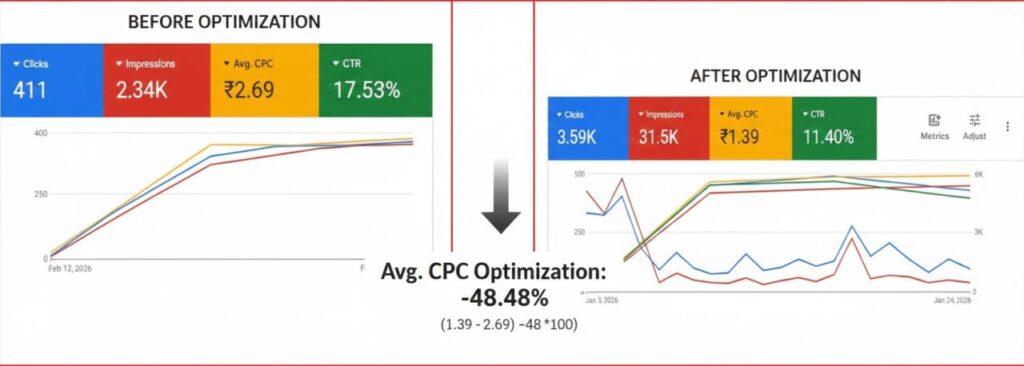
Using the same ads, we reduced Average CPC from ₹2.69 to ₹1.39—a 48.48% drop—without increasing spend or launching anything new.
The change wasn’t in execution.
It was in how the campaign was structured and managed.
Before Optimization: What the Data Looked Like
Before any changes, the campaign showed:
- Clicks: 411
- Impressions: 2.34K
- Avg. CPC: ₹2.69
- CTR: 17.53%
Engagement was healthy, but efficiency wasn’t. The cost per click indicated that the system wasn’t allocating budget optimally—even though the creatives were performing well.
After Optimization: Same Ads, Better Efficiency
Post-optimization results told a very different story:
- Clicks: 3.59K
- Impressions: 31.5K
- Avg. CPC: ₹1.39
- CTR: 11.40%
The most important shift wasn’t just lower CPC—it was scale with control.
More impressions, more clicks, and significantly lower cost per interaction.
All without changing the ads.
What Actually Changed?
1. Cleaner Campaign Structure
Over time, many ad accounts become cluttered:
- Too many ad sets
- Overlapping targeting
- Fragmented data signals
We simplified the structure so each campaign had a clear purpose. This helped the algorithm understand where and how to spend.
2. Smarter Targeting Logic
Instead of forcing narrow assumptions, we focused on:
- Reducing audience overlap
- Allowing broader, high-intent signals
- Consolidating data instead of splitting it
This gave the system room to optimize more efficiently.
3. Fewer Unnecessary Tweaks
One of the most common mistakes in paid ads is constant intervention.
Frequent bid changes, pausing ads, or micro-optimizations reset learning phases repeatedly. We stopped doing that.
By letting the algorithm learn instead of restarting, performance stabilized—and CPC dropped naturally.
Why Simplification Works
Modern ad platforms are powered by machine learning. They perform best when:
- Data isn’t fragmented
- Signals are consistent
- Learning phases are respected
Complexity often creates noise, not intelligence.
Simplification creates clarity—and clarity drives efficiency.
The Bigger Lesson
This campaign reinforced a belief I stand by strongly:
Performance improves when we simplify, not complicate.
Good results don’t always come from:
- More ads
- More changes
- More experimentation
Sometimes, they come from doing things right.
Final Thought
If your campaigns feel stuck or expensive, the solution might not be something new.
It might be:
- Cleaning up the structure
- Trusting the system
- Giving optimization time to work
Because in performance marketing, clarity beats chaos—every time.