
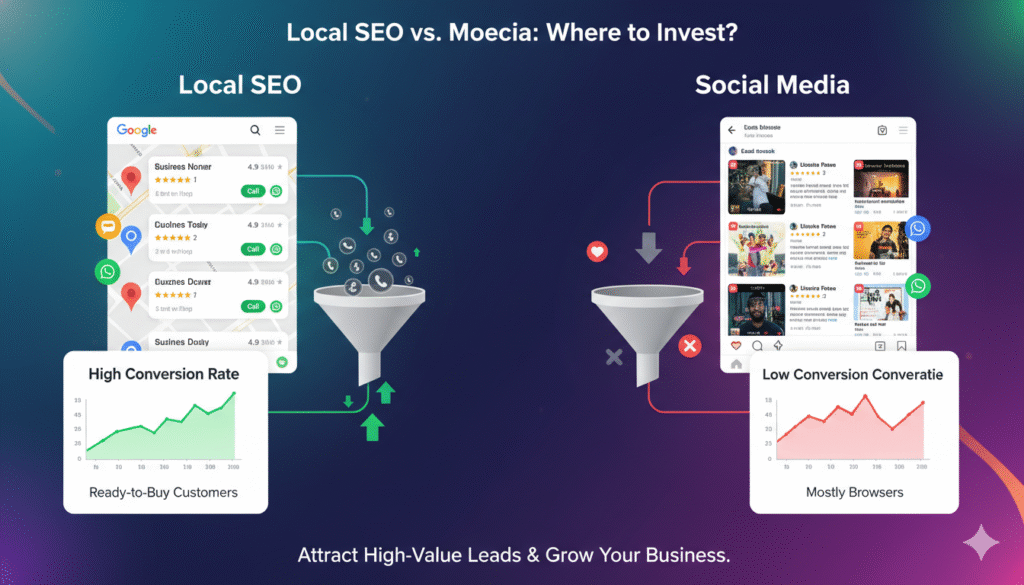
Why Local SEO Works Better Than Social Media for Service Businesses
Many service businesses invest heavily in social media—posting regularly, running ads, and trying to grow followers. While social media has its place, most business owners eventually ask the same question:
“Why aren’t we getting consistent leads?”
In 2026, the answer is becoming clearer:
For service-based businesses, Local SEO consistently outperforms social media when it comes to generating real, high-intent leads.
Let’s break down why.
The Core Difference: Intent vs Attention
The biggest difference between Local SEO and social media is user intent.
Social Media
People scroll social platforms to:
- Be entertained
- Pass time
- Watch videos
- Engage casually
They are not actively looking for a service.
Local SEO
People search Google when they:
- Need a solution
- Want to contact a business
- Are ready to take action
Search intent is problem-driven, not entertainment-driven.
That’s why Local SEO converts better.
Local SEO Targets “Ready-to-Buy” Users
When someone searches:
- “plumber near me”
- “best digital marketing agency in Bhubaneswar”
- “clinic open now”
They are not browsing—they are deciding.
Local SEO places your business in front of users who:
- Already need your service
- Are comparing options
- Are likely to call or message immediately
Social media rarely captures users at this stage.
Google Maps = Direct Calls, Not Likes
One of the biggest advantages of Local SEO is Google Maps visibility.
Google Maps listings offer:
- One-tap call buttons
- Directions to your location
- Reviews and trust signals
- Immediate contact options
There’s no scrolling, no convincing, no nurturing.
Users see → trust → call.
Social media, on the other hand, often requires:
- Multiple interactions
- Repeated exposure
- Retargeting ads
Which increases cost and delays conversions.
Local SEO Builds Trust Faster
Trust plays a huge role in service businesses.
Local SEO naturally includes:
- Google reviews
- Star ratings
- Location verification
- Business consistency
These trust signals are visible before a user clicks your website.
On social media, trust takes time to build and often depends on:
- Content consistency
- Engagement signals
- Paid promotion
Local SEO shortens the trust-building process.
Lower Cost, Better ROI
Social media often requires:
- Continuous content creation
- Paid boosts to reach new users
- Retargeting to stay visible
Local SEO, once optimized:
- Brings consistent traffic
- Doesn’t charge per click
- Improves over time
For service businesses with limited budgets, Local SEO delivers better long-term ROI.
Social Media Works Best as a Support Channel
This doesn’t mean social media is useless.
Social media works best for:
- Brand awareness
- Retargeting website visitors
- Supporting Local SEO trust
- Staying top-of-mind
But relying on social media alone for lead generation is risky—especially for service-based businesses.
When Social Media Makes More Sense
Social media can outperform Local SEO if:
- You sell impulse-driven products
- Your business is heavily visual
- You rely on brand storytelling
- Your service requires education before conversion
Even then, Local SEO should still be part of the strategy.
The Best Strategy in 2026
The smartest service businesses use:
- Local SEO for consistent, high-intent leads
- Social media to support trust, branding, and remarketing
But if you must choose one channel to start with—Local SEO wins.
Final Thoughts
Social media gets attention.
Local SEO gets customers.
For service businesses, growth comes from:
- Being visible when users search
- Showing up on Google Maps
- Making it easy to call or message
In 2026, Local SEO isn’t just a marketing option—it’s a core growth channel for service-based businesses.