
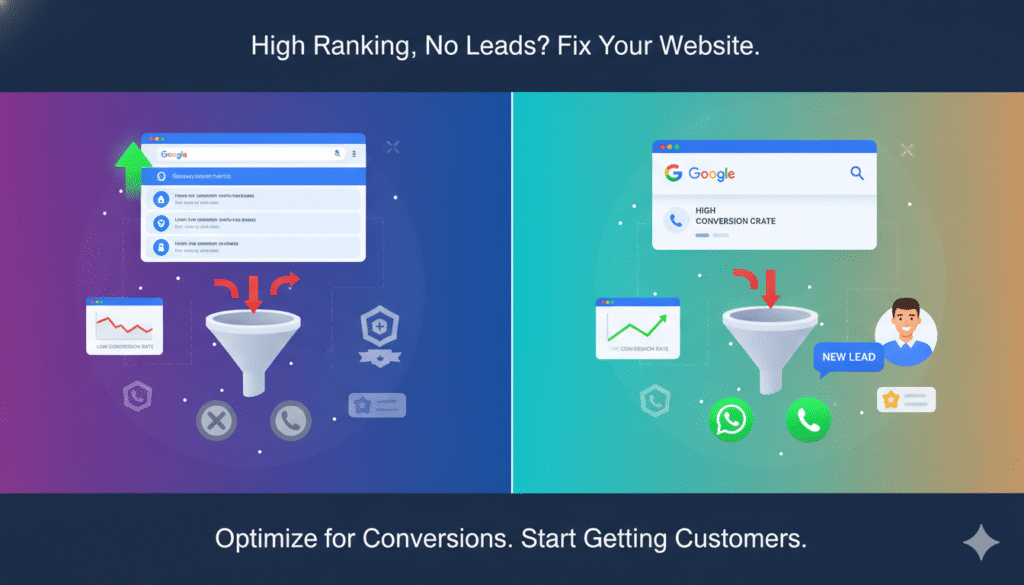
Why Your SEO Is Ranking but Not Bringing Leads (And How to Fix It in 2026)
You finally see your website ranking on Google.
Impressions are increasing.
Traffic is coming in.
But then comes the frustrating realization:
SEO is ranking… yet leads are not coming.
This is one of the most common problems businesses face in 2026. And the truth is, ranking alone doesn’t guarantee business growth. SEO success today is about visibility plus conversion.
Let’s break down why this happens—and how to fix it.
1. Ranking for the Wrong Keywords
Not all rankings are valuable.
Many websites rank for:
- Informational keywords
- Broad, non-commercial terms
- Searches with no buying intent
These keywords bring traffic, but not customers.
How to fix it
Focus on high-intent keywords, such as:
- Service-based searches
- Location-specific queries
- “Near me” and solution-driven searches
SEO should attract users who are ready to act, not just browse.
2. Your Ranking Pages Are Not Built to Convert
Often, blogs or generic pages rank—but they aren’t designed to generate leads.
Common issues:
- No clear call-to-action
- Contact details hard to find
- Content educates but doesn’t guide
How to fix it
Every ranking page should:
- Clearly explain the service or solution
- Include visible CTAs (Call, WhatsApp, Book Now)
- Guide users to the next step
Ranking pages must support decision-making, not just information.
3. Poor Local Relevance
If you’re a local business, generic SEO won’t convert well.
Even if you rank, users hesitate when:
- Location is unclear
- Local proof is missing
- Google Business Profile and website don’t align
How to fix it
Strengthen local SEO by:
- Adding location-focused service pages
- Aligning content with Google Business Profile
- Showing address, service area, and local trust signals
Local relevance increases confidence—and leads.
4. Website Experience Kills Conversion
Many SEO visitors leave because:
- The site loads slowly
- Mobile experience is poor
- Navigation is confusing
- Forms don’t work properly
Google may rank your site, but users still judge the experience.
How to fix it
Optimize for:
- Fast load times
- Mobile-first design
- Simple navigation
- Clear contact options
User experience is now a core SEO and conversion factor.
5. No Trust Signals on High-Traffic Pages
SEO brings strangers to your site.
Trust convinces them to contact you.
Missing trust signals include:
- Reviews and testimonials
- Case studies or results
- Client logos or certifications
Without trust, users read and leave.
How to fix it
Add trust elements near CTAs on ranking pages to reduce hesitation.
6. SEO Is Not Connected to Conversion Tracking
Many businesses don’t actually know:
- Which SEO pages generate leads
- Which keywords convert
- Where users drop off
Without tracking, SEO optimization becomes guesswork.
How to fix it
Track:
- Calls
- WhatsApp clicks
- Form submissions
- Page-level conversions
This allows SEO to evolve from ranking-focused to revenue-focused.
7. SEO Is Treated as a Standalone Channel
SEO performs best when supported by:
- Google Ads (for high-intent terms)
- Local SEO (Maps + reviews)
- Conversion optimization
When SEO operates alone, lead potential drops.
How to fix it
Integrate SEO into a broader lead-generation system.
Final Thoughts
In 2026, SEO success is not just about ranking—it’s about what happens after the click.
If your SEO is ranking but not bringing leads, the problem is usually:
- Intent mismatch
- Poor conversion structure
- Weak trust signals
- Lack of tracking
Fix these, and SEO stops being a visibility tool—and becomes a lead engine.